Where Is the West Fork Cafe in the Movie the Gordon Family Tree
| Annie Hall | |
|---|---|
 Theatrical release poster | |
| Directed past | Woody Allen |
| Written by | Woody Allen Marshall Brickman |
| Produced by | Charles H. Joffe Jack Rollins (uncredited) |
| Starring |
|
| Cinematography | Gordon Willis |
| Edited by | Ralph Rosenblum Wendy Greene Bricmont |
| Music by | See Soundtrack |
| Production | A Jack Rollins and Charles H. Joffe Production |
| Distributed by | United Artists |
| Release dates |
|
| Running fourth dimension | 93 minutes |
| Country | United States |
| Languages | English language German |
| Budget | $4 1000000 |
| Box function | $38.three million[ane] |
Annie Hall is a 1977 American satirical romantic comedy-drama picture show directed by Woody Allen from a screenplay he co-wrote with Marshall Brickman, and produced by Allen's managing director, Charles H. Joffe. The film stars Allen every bit Alvy Vocalizer, who tries to figure out the reasons for the failure of his relationship with the eponymous female person lead, played by Diane Keaton in a role written specifically for her.
Primary photography for the film began on May 19, 1976, on the South Fork of Long Isle, and continued periodically for the side by side 10 months. Allen has described the result, which marked his showtime collaboration with cinematographer Gordon Willis, equally "a major turning point",[2] in that unlike the farces and comedies that were his work to that betoken, it introduced a new level of seriousness. Academics accept noted the dissimilarity in the settings of New York City and Los Angeles, the stereotype of gender differences in sexuality, the presentation of Jewish identity, and the elements of psychoanalysis and modernism.
Annie Hall was screened at the Los Angeles Film Festival on March 27, 1977, before its official release in the United States on April xx, 1977. The film was highly praised, was nominated for the Large V Academy Awards, winning 4: the Academy Award for Best Picture, two for Allen (Best Manager and, with Brickman, Best Original Screenplay), and Best Extra for Keaton. The film additionally won 4 BAFTA awards and a Aureate Earth, the latter being awarded to Keaton. The film's North American box function receipts of $38,251,425 are fourth-best of Allen'due south works when not adjusted for aggrandizement.
Considered to exist i of the best films ever made, information technology ranks 31st on AFI's List of the greatest films in American cinema, quaternary on their list of greatest comedy films and 28th on Bravo's "100 Funniest Movies". Film critic Roger Ebert chosen information technology "just well-nigh everyone'due south favorite Woody Allen flick".[3] The motion picture's screenplay was as well named the funniest ever written by the Writers Guild of America in its list of the "101 Funniest Screenplays".[4] In 1992, the United States Library of Congress selected the film for preservation in the National Film Registry every bit being "culturally, historically, or aesthetically significant."[5]
Plot [edit]
The comedian Alvy Vocalist is trying to understand why his human relationship with Annie Hall ended a year agone. Growing upwards in Brooklyn, he vexed his female parent with incommunicable questions about the emptiness of being, simply he was precocious about his innocent sexual curiosity, suddenly kissing a classmate at 6 years erstwhile and not understanding why she was not groovy to reciprocate.
Annie and Alvy, in a line for The Sorrow and the Pity, eavesdrop some other man deriding the work of Federico Fellini and Marshall McLuhan; Alvy imagines McLuhan himself stepping in at his invitation to criticize the man'due south comprehension. That night, Annie shows no interest in sex with Alvy. Instead, they discuss his first married woman, whose ardor gave him no pleasance. His second marriage was to a New York writer who didn't like sports and was unable to reach orgasm.
With Annie, it is different. The 2 of them have fun making a meal of boiled lobster together. He teases her about the unusual men in her past. He met her playing tennis doubles with friends. Post-obit the game, awkward small talk led her to offer him first a ride uptown and and so a glass of wine on her balcony. There, what seemed a balmy exchange of fiddling personal data is revealed in "mental subtitles" equally an escalating amour. Their offset date follows Annie'southward singing audition for a night club ("It Had to be You"). After their lovemaking that night, Alvy is "a wreck", while she relaxes with a articulation.
Soon Annie admits she loves him, while he buys her books on expiry and says that his feelings for her are more than only love. When she moves in with him, things become very tense. Eventually, he finds her arm in arm with one of her college professors and the two begin to debate whether this is the "flexibility" they had discussed. They eventually interruption up, and he searches for the truth of relationships, asking strangers on the street almost the nature of beloved, questioning his formative years, and imagining a cartoon version of himself arguing with a cartoon Annie portrayed equally the Evil Queen in Snowfall White.
Alvy returns to dating, but the effort is marred by neurosis and bad sex that is interrupted when Annie insists he come up over immediately to kill a spider in her bath. A reconciliation follows, coupled with a vow to stay together come what may. Even so, their divide discussions with their therapists make information technology evident there is an unspoken and unbridgeable carve up. When Alvy accepts an offer to present an award on goggle box, they fly out to Los Angeles, with Alvy's friend, Rob. However, on the render trip, they concord that their relationship is not working. After losing her to her record producer, Tony Lacey, Alvy unsuccessfully tries rekindling the flame with a marriage proposal. Dorsum in New York, he stages a play of their relationship just changes the ending: at present she accepts.
The concluding coming together for them is a wistful coda on New York's Upper Westward Side when they have both moved on to someone new. Alvy'southward voice returns with a summation: love is essential, especially if it is neurotic. Annie sings "Seems Like Old Times" and the credits scroll.
Cast [edit]
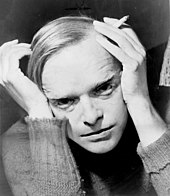
Truman Capote, pictured here in 1959, had a cameo role in the motion picture.
- Woody Allen every bit Alvy Vocalist
- Diane Keaton as Annie Hall
- Tony Roberts as Rob
- Carol Kane as Allison Portchnik
- Paul Simon as Tony Lacey
- Janet Margolin every bit Robin
- Shelley Duvall as Pam
- Christopher Walken (credited as "Christopher Wlaken")[a] equally Duane Hall
- Colleen Dewhurst every bit Mrs. Hall
- Donald Symington as Mr. Hall
- Joan Newman as Mrs. Vocalist
- Marshall McLuhan as Himself
- Mordecai Lawner as Alvy's father
Truman Capote has a cameo. Alvy is making quips nearly people walking by. He says "There's the winner of the Truman Capote look-alike contest" as Truman Capote walks through the frame.[7] Several actors who later gained a higher profile had small parts in the motion-picture show: John Glover as Annie's histrion boyfriend, Jerry; Jeff Goldblum as a man who "forgot [his] mantra" at Tony Lacey'southward Christmas party; Beverly D'Angelo every bit an extra in Rob'southward Telly show; and Sigourney Weaver, in her flick debut, in the endmost sequence as Alvy's appointment at the movie house. Laurie Bird also appears, two years before her suicide.
Way and technique [edit]
Technically, the picture show marked an accelerate for the director. He selected Gordon Willis as his cinematographer—for Allen "a very of import teacher" and a "technical magician," maxim, "I really count Annie Hall every bit the showtime step toward maturity in some style in making films."[8] At the time, it was considered an "odd pairing" past many, Keaton amid them. The manager was known for his comedies and farces, while Willis was known as "the prince of darkness" for work on dramatic films like The Godfather.[9] Despite this, the two became friends during filming and continued the collaboration on several after films, including Zelig, which earned Willis his get-go University Award nomination for Best Cinematography.[9]
Willis described the product for the flick as "relatively easy."[nine] He shot in varying styles; "hot golden light for California, greyness overcast for Manhattan and a forties Hollywood glossy for ... dream sequences," almost of which were cutting.[10] It was his suggestion which led Allen to movie the dual therapy scenes in 1 set divided by a wall instead of the usual dissever screen method.[nine] He tried long takes, with some shots, unabridged, lasting an unabridged scene, which, for Ebert, add to the dramatic power of the film: "Few viewers probably notice how much of Annie Hall consists of people talking, simply talking. They walk and talk, sit and talk, go to shrinks, get to lunch, make love and talk, talk to the photographic camera, or launch into inspired monologues like Annie'due south free-association every bit she describes her family unit to Alvy. This speech by Diane Keaton is as close to perfect every bit such a speech can probable be ... all done in one take of vivid brinksmanship." He cites a report that calculated the boilerplate shot length of Annie Hall to exist 14.v seconds, while other films made in 1977 had an average shot length of 4–7 seconds.[3] Peter Cowie suggests that "Allen breaks up his extended shots with more than orthodox cutting back and forth in conversation pieces so that the forward momentum of the moving-picture show is sustained."[11] Bernd Herzogenrath notes the innovation in the use of the split-screen during the dinner scene to powerfully exaggerate the contrast between the Jewish and the gentile family.[12]
Although the movie is not essentially experimental, at several points it undermines the narrative reality.[13] James Bernardoni notes Allen's way of opening the film past facing the camera, which immediately intrudes upon audience interest in the film.[14] In 1 scene, Allen's character, in line to see a pic with Annie, listens to a man behind him deliver misinformed pontifications on the significance of Fellini'south and Marshall McLuhan'due south work. Allen pulls McLuhan himself from just off-camera to correct the man'south errors personally.[3] Later on in the motion picture, when we see Annie and Alvy in their offset extended talk, "mental subtitles" convey to the audience the characters' nervous inner doubts.[iii] An animated scene—with artwork based on the comic strip Inside Woody Allen—depicts Alvy and Annie in the guise of the Wicked Queen from Snow White.[3] Although Allen uses each of these techniques only once, the "fourth wall" is broken several other times when characters accost the camera straight. In one, Alvy stops several passers-by to ask questions about dear, and in another, he shrugs off writing a happy ending to his human relationship with Annie in his autobiographical starting time play as forgivable "wish-fulfillment." Allen chose to take Alvy break the fourth wall, he explained, "because I felt many of the people in the audience had the same feelings and the aforementioned problems. I wanted to talk to them directly and confront them."[viii]
Production [edit]
Writing [edit]
The idea for what would become Annie Hall was developed as Allen walked effectually New York City with co-writer Marshall Brickman. The pair discussed the project frequently, sometimes condign frustrated and rejecting the idea. Allen wrote a first draft of a screenplay within a four-day period, sending information technology to Brickman to make alterations. According to Brickman, this draft centered on a man in his forties, someone whose life consisted "of several strands." One was a relationship with a young woman, another was a concern with the boiler of the life that we all live, and a 3rd an obsession with proving himself and testing himself to detect out what kind of character he had. Allen himself turned 40 in 1975, and Brickman suggests that "advancing historic period" and "worries about death" had influenced Allen'south philosophical, personal approach to complement his "commercial side".[15] [16] Allen fabricated the conscious decision to "sacrifice some of the laughs for a story about homo beings".[nine] He recognized that for the start time he had the backbone to carelessness the safety of complete broad comedy and had the volition to produce a film of deeper meaning which would be a nourishing experience for the audience.[ii] He was as well influenced by Federico Fellini's comedy-drama 8½ (1963), created at a similar personal turning indicate, and similarly colored past each director'due south psychoanalysis.[16]
Brickman and Allen sent the screenplay back and along until they were ready to ask United Artists for $four million.[16] Many elements from the early drafts did not survive. It was originally a drama centered on a murder mystery with a comic and romantic subplot.[17] According to Allen, the murder occurred afterward a scene that remains in the film, the sequence in which Annie and Alvy miss the Ingmar Bergman film Face to Face (1976).[18] Although they decided to drop the murder plot, Allen and Brickman made a murder mystery many years later: Manhattan Murder Mystery (1993), as well starring Diane Keaton.[xix] The draft that Allen presented to the film'southward editor, Ralph Rosenblum, concluded with the words, "catastrophe to be shot."[20]
Allen suggested Anhedonia, a term for the disability to experience pleasure, as a working championship,[21] [22] and Brickman suggested alternatives including It Had to Be Jew, Rollercoaster Named Desire and Me and My Goy.[23] An advertizement agency, hired by United Artists, embraced Allen'south choice of an obscure word by suggesting the studio accept out newspaper advertisements that looked similar fake tabloid headlines such equally "Anhedonia Strikes Cleveland!".[23] Even so, Allen experimented with several titles over five exam screenings, including Anxiety and Annie and Alvy, before settling on Annie Hall.[23]
Casting [edit]
Several references in the film to Allen's own life have invited speculation that it is autobiographical. Both Alvy and Allen were comedians. His altogether appears on the blackboard in a school scene, and "Alvy" was one of Allen's childhood nicknames;[24] certain features of his childhood are plant in Alvy Singer's;[25] Allen went to New York Academy and so did Alvy. Diane Keaton'due south real surname is "Hall" and "Annie" was her nickname, and she and Allen were in one case romantically involved.[26] However, Allen is quick to dispel these suggestions. "The stuff that people insist is autobiographical is almost invariably not," Allen said. "It'south so exaggerated that it's virtually meaningless to the people upon whom these little nuances are based. People got information technology into their heads that Annie Hall was autobiographical, and I couldn't convince them it wasn't".[27] Contrary to various interviewers and commentators, he says, Alvy is not the character that is closest to himself; he identified more with the female parent (Eve, played by Geraldine Folio) in his side by side film, Interiors.[28] Despite this, Keaton has stated that the relationship between Alvy and Annie was partly based on her human relationship with the director.[29]
The role of Annie Hall was written specifically for Keaton, who had worked with Allen on Play It Once more, Sam (1972), Sleeper (1973) and Beloved and Death (1975).[29] She considered the character an "affable version" of herself—both were "semi-articulate, dreamed of being a singer and suffered from insecurity"—and was surprised to win an Oscar for her performance.[29] The pic also marks the second film collaboration between Allen and Tony Roberts, their previous project being Play It Once more, Sam.[9]
Federico Fellini was Allen'southward first selection to appear in the movie theatre lobby scene considering his films were under discussion,[18] just Allen chose cultural academic Marshall McLuhan after both Fellini and Luis Buñuel declined the cameo.[30] Some bandage members, biographer John Baxter claims, were aggrieved at Allen'southward treatment of them. The director "acted coldly" towards McLuhan, who had to return from Canada for reshooting, and Mordecai Lawner, who played Alvy'due south father, claimed that Allen never spoke to him.[30] All the same, during the production, Allen began a 2-year relationship with Stacey Nelkin, who appears in a single scene.[thirty]
Filming, editing and music [edit]
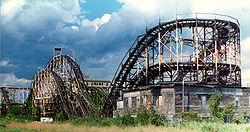
Principal photography began on May xix, 1976, on the South Fork of Long Isle with the scene in which Alvy and Annie boil live lobsters; filming continued periodically for the next 10 months,[31] and deviated often from the screenplay. There was aught written about Alvy's childhood dwelling house lying nether a roller coaster, but when Allen was scouting locations in Brooklyn with Willis and art manager Mel Bourne, he "saw this roller-coaster, and ... saw the house under it. And I thought, we accept to utilize this."[25] Similarly, there is the incident where Alvy scatters a trove of cocaine with an adventitious sneeze: although not in the script, the joke emerged from a rehearsal happenstance and stayed in the motion-picture show. In audience testing, this laugh was then sustained that a much longer intermission had to exist added so that the following dialogue was not lost.[32]
Editor Ralph Rosenblum's first associates of the film in 1976 left Brickman disappointed. "I felt that the motion-picture show was running off in 9 different directions," Brickman recalled.[33] "It was like a first draft of a novel... from which ii or three films could maybe be assembled."[34] Rosenblum characterized the starting time cut, at two hours and 20 minutes,[35] as "the surrealistic and abstruse adventures of a neurotic Jewish comedian who was reliving his highly flawed life and in the process satirizing much of our culture... a visual monologue, a more sophisticated and more than philosophical version of Take the Coin and Run".[35] Brickman found it "nondramatic and ultimately uninteresting, a kind of cerebral practise."[36] He suggested a more than linear narrative.[37]
The present-tense relationship between Alvy and Annie was non the narrative focus of this first cut, but Allen and Rosenblum recognized it equally the dramatic spine, and began reworking the film "in the direction of that relationship."[38] Rosenblum recalled that Allen "had no hesitation about trimming away much of the first twenty minutes in order to plant Keaton more quickly."[36] According to Allen, "I didn't sit downward with Marshall Brickman and say, 'We're going to write a moving picture about a human relationship.' I mean the whole concept of the picture changed as nosotros were cutting it."[37]
Equally the flick was approaching for 2 weeks of mail-product photography,[xx] late 1976 saw 3 separate shoots for the final segment, just just some of this cloth was used.[39] The narration that ends the film, featuring the joke about 'nosotros all need the eggs', was conceived and recorded only two hours earlier a examination screening.[39]
The credits call the film "A Jack Rollins and Charles H. Joffe Product"; the 2 men were Allen's managers and received this same credit on his films from 1969 to 1993. However, for this film, Joffe took producer credit and therefore received the Academy Award for Best Motion picture. The title sequence features a blackness groundwork with white text in the Windsor Light Condensed typeface, a design that Allen would use on his subsequent films. Stig Björkman sees some similarity to Ingmar Bergman'due south unproblematic and consequent title design, although Allen says that his own choice is a toll-saving device.[40]
Very little background music is heard in the film, a departure for Allen influenced by Ingmar Bergman.[40] Diane Keaton performs twice in the jazz club: "It Had to be You" and "Seems Like Old Times" (the latter reprises in voiceover on the closing scene). The other exceptions include a boy'southward choir "Christmas Medley" played while the characters drive through Los Angeles, the Molto allegro from Mozart's Jupiter Symphony (heard as Annie and Alvy drive through the countryside), Tommy Dorsey'southward performance of "Sleepy Lagoon",[41] and the anodyne cover of the Savoy Chocolate-brown song "A Hard Way to Go" playing at a party in the mansion of Paul Simon'southward character.
Soundtrack [edit]
- "Seems Similar Sometime Times" (1945) - Music by Carmen Lombardo - Lyrics by John Jacob Loeb - Sung past Diane Keaton (uncredited) accompanied by Artie Butler (uncredited)
- "It Had To Be You" (1924) - Music by Isham Jones - Lyrics past Gus Kahn - Sung past Diane Keaton (uncredited) accompanied by Artie Butler (uncredited)
- "A Difficult Way To Get" (1977) - Written and performed by Tim Weisberg
- "Christmas Medley" (Traditional Christmas songs: "Nosotros Wish Y'all a Merry Christmas" (uncredited), "O, Christmas Tree" (uncredited) and "God Residuum You Merry, Gentlemen" (uncredited)) - Lyrics by Ernst Anschütz - Performed past the Do-Re-Mi Children'due south Chorus
- "Sleepy Lagoon" (1930) - Composed by Eric Coates - Performed by Tommy Dorsey
- "Symphony No. 41 in C Major, Thousand. 551, Molto Allegro" (1788) (uncredited) - Written by Wolfgang Amadeus Mozart
Release [edit]
Box office and release [edit]
Annie Hall was shown at the Los Angeles Film Festival on March 27, 1977,[21] earlier its official release in the Us on Apr 20, 1977.[ane] The film ultimately earned $38,251,425 ($163 million in 2020 dollars) in the U.s.a. confronting a $4-one thousand thousand budget, making information technology the 11th highest-grossing picture show of 1977.[1] On raw figures, it currently ranks as Allen's quaternary-highest-grossing picture, after Manhattan, Hannah and Her Sisters and Midnight in Paris; when adjusted for inflation, the gross effigy makes it Allen's biggest box function hit.[42] It was first released on Blu-ray on Jan 24, 2012, alongside Allen's film Manhattan (1979).[43] Both releases include the films' original theatrical trailers.[43]
Reception [edit]
Critical response [edit]

Diane Keaton received critical acclamation and numerous accolades for her performance.
Annie Hall was met with widespread critical acclaim upon its release. Tim Radford of The Guardian chosen the flick "Allen'south almost closely focused and daring flick to date".[44] The New York Times' Vincent Canby preferred Annie Hall to Allen's second directorial effort, Take the Coin and Run, since the former is more than "humane" while the latter is more a "cartoon".[45] Several critics take compared the film favorably to Bergman'due south Scenes from a Wedlock (1973),[45] [46] [47] including Joseph McBride in Diverseness, who found it Allen'southward "most iii-dimensional film to date" with an ambition equal to Bergman's best even as the co-stars go the "contemporary equivalent of ... Tracy-Hepburn."[46]
More than critically, Peter Cowie commented that the pic "suffers from its profusion of cultural references and asides".[48] Writing for New York mag, John Simon called the film "unfunny comedy, poor moviemaking, and embarrassing cocky-revelation," and wrote that Keaton's operation was "in bad taste to watch and indecency to display," saying that the office should accept been played by Robin Mary Paris, the actress who appears briefly in the scene where Alvy Singer has written a two-character play nakedly based on himself and Annie Hall. Simon's review of Annie Hall "It is a film and then shapeless, sprawling, repetitious, and aimless equally to seem to beg for oblivion. At this, it is successful."[49]
The picture show has connected to receive positive reviews. In his 2002 lookback, Roger Ebert added it to his Great Movies list and commented with surprise that the movie had "an instant familiarity" despite its historic period,[iii] and Slant writer Jaime North. Christley found the one-liners "still gut-busting after 35 years".[47] A later on Guardian critic, Peter Bradshaw, named it the best comedy picture show of all time, commenting that "this wonderfully funny, unbearably sad flick is a miracle of comic writing and inspired picture show-making".[50] John Marriott of the Radio Times believed that Annie Hall was the film where Allen "plant his ain singular voice, a vocalization that echoes beyond events with a mixture of exuberance and introspection", referring to the "comic please" derived from the "spirited playing of Diane Keaton as the kooky innocent from the Midwest, and Woody himself every bit the fumbling New York neurotic".[51] Empire magazine rated the pic 5 out of 5 stars, calling it a "archetype".[52] In 2017, Claire Dederer wrote, "Annie Hall is the greatest comic film of the twentieth century [...] considering it acknowledges the irrepressible nihilism that lurks at the centre of all comedy."[53]
The Japanese filmmaker Akira Kurosawa cited Annie Hall as 1 of his favorite films.[54] [55]
On review aggregator Rotten Tomatoes, the picture has a rating of 96% based on 83 reviews, with an average rating of ix.1/x. The site'due south critical consensus reads, "Filled with poignant performances and devastating humor, Annie Hall represents a quantum leap for Woody Allen and remains an American classic."[56] Metacritic gave the moving-picture show a score of 92 out of 100 based on 20 critical reviews, indicating "universal acclamation".[57]
Critical analysis [edit]
Love and sexuality [edit]

Sociologists Virginia Rutter and Pepper Schwartz consider Alvy and Annie's relationship to be a stereotype of gender differences in sexuality.[58] The nature of honey is a repeating subject for Allen and co-star Tony Roberts described this film as "the story of everybody who falls in love, and then falls out of beloved and goes on."[9] Alvy searches for dear'south purpose through his effort to get over his depression near the demise of his relationship with Annie. Sometimes he sifts through his memories of the relationship, at another indicate he stops people on the sidewalk, with one woman maxim that "It'due south never something you lot practice. That'south how people are. Love fades," a proposition that information technology was no one'south mistake, they only grew autonomously and the end was inevitable. By the end of the film, Alvy accepts this and decides that honey is ultimately "irrational and crazy and absurd", but a necessity of life.[59] Christopher Knight believes Alvy's quest upon coming together Annie is carnal, whereas hers is on an emotional note.[60]
Richard Brody of The New Yorker notes the picture show's "Eurocentric fine art-house self-sensation" and Alvy Singer's "psychoanalytic obsession in baring his sexual desires and frustrations, romantic disasters, and neurotic inhibitions".[61]
Jewish identity [edit]
Vocalizer is identified with the stereotypical neurotic Jewish male, and the differences between Alvy and Annie are often related to the perceptions and realities of Jewish identity. Vincent Brook notes that "Alvy dines with the WASP-y Hall family and imagines that they must see him as a Hasidic Jew, complete with payot (ear locks) and a large black lid."[62] Robert M. Seltzer and Norman J. Cohen highlight the scene in which Annie remarks that Annie'southward grandmother "hates Jews. She thinks they simply brand coin, simply she's the one. Is she e'er, I'm telling you.", revealing the hypocrisy in her grandmother's stereotypical American view of Jews by arguing that "no stigma attaches to the love of money in America".[63] Bernd Herzogenrath also considers Allen'south joke, "I would like to but we need the eggs", to the md at the end when he suggests putting him in a mental institution, to exist a paradox of not only the persona of the urban neurotic Jew but besides of the film itself.[12]
Woody Allen persona [edit]
Christopher Knight points out that Annie Hall is framed through Alvy'south experiences. "Generally, what we know about Annie and well-nigh the human relationship comes filtered through Alvy, an intrusive narrator capable of halting the narrative and stepping out from it in gild to entreat the audience's interpretative favor."[64] He suggests that because Allen'southward films mistiness the protagonist with "past and future protagonists likewise equally with the director himself", information technology "makes a difference as to whether nosotros are near responsive to the managing director's or the grapheme'due south framing of events".[65] Despite the narrative's framing, "the joke is on Alvy."[66] Emanuel Levy believes that Alvy Singer became synonymous with the public perception of Woody Allen in the United States.[67] Annie Hall is viewed as the definitive Woody Allen film in displaying neurotic humor.[68]
Location [edit]

Annie Hall "is as much a dearest vocal to New York Metropolis as it is to the character,"[69] reflecting Allen'due south admiration of the island of Manhattan. It was a human relationship he explored repeatedly, particularly in films like Manhattan (1979) and Hannah and Her Sisters (1986).[9] Annie Hall's apartment, which still exists on East 70th Street between Lexington Avenue and Park Avenue is by Allen'southward own confession his favorite block in the city.[70] Peter Cowie argues that the film shows "a romanticized view" of the borough, with the camera "linger[ing] on the Upper East Side [... and where] the fearfulness of criminal offense does not trouble its characters."[71] By contrast, California is presented less positively, and David Halle notes the obvious "invidious intellectual comparing" betwixt New York City and Los Angeles.[72] While Manhattan's movie theaters show classic and foreign films, Los Angeles theaters run less-prestigious fare such as The House of Exorcism and Messiah of Evil.[71] Rob'due south demonstration of adding canned laughter to television demonstrates the "contemptuous artifice of the medium".[71] New York City serves as a symbol of Alvy'south personality ("gloomy, claustrophobic, and socially common cold, but also an intellectual haven total of nervous energy") while Los Angeles is a symbol of freedom for Annie.[69]
Psychoanalysis and modernism [edit]
Annie Hall has been cited as a film which uses both therapy and analysis for comic result.[73] Sam B. Girgus considers Annie Hall to be a story about memory and retrospection, which "dramatizes a return via narrative desire to the repressed and the unconscious in a manner like to psychoanalysis".[74] He argues that the film constitutes a cocky-conscious exclamation of how narrative desire and humor collaborate in the film to reform ideas and perceptions and that Allen's deployment of Freudian concepts and humor forms a "pattern of skepticism toward surface meaning that compels farther estimation". Girgus believes that proof of the pervasiveness of Sigmund Freud in the moving picture is demonstrated at the beginning through a reference to a joke in Jokes and Their Relation to the Unconscious, and makes another joke about a psychiatrist and patient, which Girgus argues is likewise symbolic of the dynamic between humor and the unconscious in the moving picture.[74] Further Freudian concepts are later addressed in the film with Annie's recall of a dream to her psychoanalyst in which Frank Sinatra is smothering her with a pillow, which alludes to Freud's conventionalities in dreams every bit "visual representations of words or ideas".[74]
Peter Bailey in his book The Reluctant Film Art of Woody Allen, argues that Alvy displays a "genial denigration of art" which contains a "significant equivocation", in that in his self-deprecation he invites the audience to believe that he is leveling with them.[75] Bailey argues that Allen's devices in the film, including the subtitles which reveal Annie'due south and Alvy's thoughts "extend and reinforce Annie Hall 'southward winsome ethos of plain-dealing and ingenuousness".[75] He muses that the film is full of antimimetic emblems such as McLuhan'southward magical appearance which provide quirky humor and that the "disparity between mental projections of reality and actuality" drives the film. His view is that self-reflective cinematic devices intelligently dramatize the difference betwixt surface and substance, with visual emblems "incessantly distilling the distinction betwixt the earth mentally constructed and reality".[75]
In his discussion of the film'southward relation to modernism, Thomas Schatz finds the film an unresolved "test of the process of human interaction and interpersonal communication"[76] and "immediately establishes [a] self-referential stance" that invites the spectator "to read the narrative as something other than a sequential development toward some transcendent truth".[77] For him, Alvy "is the victim of a tendency toward overdetermination of meaning – or in modernist terms 'the tyranny of the signified' – and his involvement with Annie can be viewed equally an attempt to found a spontaneous, intellectually unencumbered relationship, an attempt which is doomed to failure."[76]
Awards and accolades [edit]
| University Awards | |
|---|---|
| ane. All-time Picture, Charles H. Joffe | |
| 2. All-time Director, Woody Allen | |
| iii. Best Actress in a Leading Role, Diane Keaton | |
| 4. Best Original Screenplay, Woody Allen and Marshall Brickman | |
| Gold Earth Awards | |
| 1. Best Actress–Move Picture Musical or Comedy, Diane Keaton | |
| BAFTA Awards | |
| 1. All-time Film | |
| ii. Best Direction, Woody Allen | |
| 3. Best Actress, Diane Keaton | |
| 4. All-time Editing, Ralph Rosenblum and Wendy Greene Bricmont | |
| 5. Best Screenplay, Woody Allen and Marshall Brickman | |
Annie Hall won iv Oscars at the 50th University Awards on April iii, 1978, and was nominated for v (the Big Five) in total. Producer Charles H. Joffe received the statue for Best Picture, Allen for Best Director and, with Brickman, for Best Original Screenplay, and Keaton for All-time Actress. Allen was too nominated for Best Histrion.[78] Many had expected Star Wars to win the major awards, including Brickman and Executive Producer Robert Greenhut.[ix]
The moving picture was also honored five times at the BAFTA awards. Forth with the top laurels for Best Film and the award for Movie Editing, Keaton won for Best Actress, Allen won for Best Management and All-time Original Screenplay alongside Brickman.[79] The film received only one Gilded Globe Award, for Best Picture show Actress in a Musical or Comedy (Diane Keaton), despite nominations for three other awards: Best Motion Pic (Musical or Comedy), All-time Director, and Best Film Player in a Musical or Comedy (Woody Allen).
In 1992, the United States' Library of Congress selected the flick for preservation in its National Film Registry that includes "culturally, historically, or aesthetically significant" films.[five] The film is often mentioned among the greatest comedies of all time. The American Motion-picture show Institute lists it 31st in American cinema history.[lxxx] In 2000, they named it 2nd greatest romantic comedy in American movie house.[80] Keaton's operation of "Seems Like Former Times" was ranked 90th on their list of greatest songs included in a film, and her line "La-dee-da, la-dee-da." was named the 55th greatest movie quote.[lxxx] The screenplay was named the sixth greatest screenplay by the Writers Guild of America, West[81] while IGN named it the seventh greatest comedy motion picture of all fourth dimension.[82] In 2000, readers of Total Pic magazine voted information technology the xl-second greatest one-act film of all time, and the seventh greatest romantic comedy film of all fourth dimension.[83] Several lists ranking Allen'southward best films accept put Annie Hall among his greatest piece of work.[84] [85] [86]
In June 2008, AFI revealed its 10 Tiptop ten—the best ten films in ten classic American film genres—after polling over 1,500 people from the creative customs and Annie Hall was placed 2d in the romantic comedy genre.[87] AFI also ranked Annie Hall on multiple other lists. In November 2008, Annie Hall was voted in at No. 68 on Empire magazine's listing of The 500 Greatest Movies of All Time.[88] It is also ranked #2 on Rotten Tomatoes' 25 Best Romantic Comedies, second simply to The Philadelphia Story.[89] In 2012, the film was listed as the 127th best film of all fourth dimension by the Sight & Sound critics' poll.[90] The film was besides named the 132nd best film past the Sight & Sound directors' poll.[90] In October 2013, the movie was voted by the Guardian readers as the second best film directed by Woody Allen.[91] In November 2015, the film was named the funniest screenplay by the Writers Social club of America in its list of 101 Funniest Screenplays.[92]
American Film Institute recognition [edit]
The film is recognized by American Pic Institute in these lists:
- 1998: AFI's 100 Years...100 Movies – #31[93]
- 2000: AFI'southward 100 Years...100 Laughs – #4[94]
- 2002: AFI'southward 100 Years...100 Passions – #xi[95]
- 2004: AFI's 100 Years...100 Songs:
- "Seems Like Old Times" – #xc[96]
- 2005: AFI'south 100 Years...100 Moving-picture show Quotes:
- Annie Hall: "La-dee-da, la-dee-da." – #55[97]
- Alvy Singer "I don't want to move to a city where the just cultural advantage is existence able to make a right turn on a crimson lite." – Nominated.
- Alvy Singer "Don't knock masturbation. It's sex with someone I honey." – Nominated.
- 2007: AFI's 100 Years...100 Movies (10th Anniversary Edition) – #35[98]
- 2008: AFI's 10 Peak 10:
- #two Romantic One-act Flick[99]
1992 – National Film Registry.[100]
In 2006, Premiere magazine ranked Keaton in Annie Hall as 60th in its list of the "100 Greatest Performances of All Time", and noted:
It's hard to play ditzy. ... The genius of Annie is that despite her loopy backhand, atrocious driving, and nervous tics, she's besides a complicated, intelligent woman. Keaton brilliantly displays this dichotomy of her character, especially when she yammers away on a first date with Alvy (Woody Allen), while the subtitle reads, "He probably thinks I'm a yoyo." Yo-yo? Hardly.[101]
Legacy and influence [edit]

Diane Keaton's dress style as Annie Hall; an influence on the fashion globe during the late 1970s
Although the moving-picture show received critical acclaim and several awards, Allen himself was disappointed with information technology, and said in an interview, "When Annie Hall started out, that flick was not supposed to be what I wound up with. The pic was supposed to be what happens in a guy'south mind ... Nobody understood anything that went on. The relationship between myself and Diane Keaton was all anyone cared nigh. That was not what I cared about ... In the end, I had to reduce the flick to merely me and Diane Keaton, and that relationship, and then I was quite disappointed in that moving picture".[102] Allen has repeatedly declined to brand a sequel,[103] and in a 1992 interview stated that "Sequelism has become an annoying matter. I don't think Francis Coppola should have done Godfather III considering Godfather Two was quite smashing. When they make a sequel, it'southward just a thirst for more than coin, so I don't similar that idea then much".[104]
Diane Keaton has stated that Annie Hall was her favorite office and that the movie meant everything to her.[105] When asked if being most associated with the role concerned her as an actress, she replied, "I'k not haunted by Annie Hall. I'g happy to be Annie Hall. If somebody wants to meet me that way, it's fine by me". Costume designer Ruth Morley, working with Keaton, created a look which had an influence on the mode world during the late-70s, with women adopting the style: layering oversized, mannish blazers over vests, billowy trousers or long skirts, a man's tie, and boots.[106] The look was often referred to as the "Annie Hall look".[107] Some sources suggest that Keaton herself was mainly responsible for the look, and Ralph Lauren has often claimed credit, just only 1 jacket and one tie were purchased from Ralph Lauren for apply in the film.[108] Allen recalled that Lauren and Keaton's wearing apparel style near did not terminate up in the film. "She came in," he recalled in 1992, "and the costume lady on Annie Hall said, 'Tell her not to wearable that. She tin can't wear that. It's so crazy.' And I said, 'Leave her. She'south a genius. Let'south simply exit her alone, permit her habiliment what she wants.'"[109]
The picture show's script topped the Writers Guild of America's list of 101 funniest screenplays e'er, surpassing Some Like it Hot (1959), Groundhog Day (1993), Aeroplane! (1980), and Tootsie (1982).[110] James Bernardoni states that the motion-picture show is "one of the very few romantic comedy-dramas of the New Hollywood era and one that has rightly taken its place among the classics of that reverted genre", likening the seriocomic meditation on the couple relationship to George Cukor's Adam's Rib (1949), starring Katharine Hepburn and Spencer Tracy.[14] Since its release, other romantic comedies take inspired comparison. When Harry Met Sally... (1989), Chasing Amy (1997), Burning Annie (2007), 500 Days of Summer (2009) and Allen'due south 2003 moving picture, Annihilation Else, are among them,[xc] [111] [112] [113] [114] while motion-picture show director Rian Johnson said in an interview for the book, The Film That Changed My Life, that Annie Hall inspired him to become a pic director.[115] Karen Gillan stated that she watched Annie Hall as part of her research for her lead role in Non Some other Happy Ending.[116] In 2018, Matt Starr and Ellie Sachs released a curt film remake starring senior citizens.[117] [118]
Note [edit]
- ^ Misspelled as "Christopher Wlaken" in the closing credits.[6]
References [edit]
- ^ a b c "Annie Hall, Box Office Data". Box Function Mojo. Archived from the original on January thirteen, 2012. Retrieved January 29, 2012.
- ^ a b Björkman 1995, p. 75
- ^ a b c d e f Ebert, Roger (May 12, 2002). "Annie Hall film review & movie summary (1977)". RogerEbert.com. Archived from the original on April xiv, 2013. Retrieved January 10, 2021.
- ^ McNary, Dave (November 11, 2015). "'Annie Hall' Named Funniest Screenplay by WGA Members". Diverseness. Archived from the original on December 22, 2017. Retrieved Dec 9, 2017.
- ^ a b "Complete National Film Registry Listing | Moving-picture show Registry | National Moving picture Preservation Lath | Programs at the Library of Congress | Library of Congress". Library of Congress, Washington, D.C. 20540 USA. Archived from the original on October 31, 2016. Retrieved May eighteen, 2020.
- ^ Sim, David (March 31, 2019). "To gloat Christopher Walken's 76th birthday, we rank his best 20 movies". Newsweek. Archived from the original on May v, 2019. Retrieved May v, 2019.
- ^ "Clip from Annie Hall". YouTube. Archived from the original on June 6, 2019. Retrieved April i, 2019.
- ^ a b Björkman 1995, p. 77
- ^ a b c d due east f g h i Weide, Robert B. (Managing director) (2011). Woody Allen: A Documentary (Television). PBS.
- ^ Baxter 1999, p. 2487
- ^ Cowie 1996, p. 47
- ^ a b Herzogenrath 2009, p. 97
- ^ Bailey, Peter J. (September 29, 2010). The Reluctant Picture Art of Woody Allen. University Press of Kentucky. p. 35. ISBN978-0813139241.
- ^ a b Bernardoni 2001, p. 164
- ^ Rosenblum & Karen 1986, p. 274
- ^ a b c Baxter 1999, p. 241
- ^ Lax 2000, p. 283
- ^ a b Björkman 1995, p. 79
- ^ Mitchell 2001, p. 123.
- ^ a b Rosenblum & Karen 1986, p. 262
- ^ a b Baxter 1999, p. 245
- ^ Gussow, Mel (April 20, 1977). "Woody Allen Fights Anhedonia". The New York Times. Archived from the original on March 12, 2017. Retrieved Feb 5, 2017.
- ^ a b c Rosenblum & Karen 1986, p. 289
- ^ a b Spignesi 1992, p. 185
- ^ a b Björkman 1995, p. 78
- ^ Björkman 1995, p. 83
- ^ 1987 interview with William Geist in Rolling Stone, cited in (Baxter 1999, p. 244) and in (Spignesi 1992, p. 188)
- ^ Björkman 1995, p. 86
- ^ a b c Diane Keaton. And so Again: A Memoir, 2011.
- ^ a b c Baxter 1999, p. 249
- ^ Baxter 1999, p. 247
- ^ Rosenblum & Karen 1986, p. 284-284
- ^ Rosenblum & Karen 1986, pp. 280–281
- ^ Rosenblum & Karen 1986, p. 278
- ^ a b Rosenblum & Karen 1986, p. 275
- ^ a b Rosenblum & Karen 1986, p. 281
- ^ a b Rosenblum & Karen 1986, p. 283
- ^ Rosenblum & Karen 1986, pp. 281–282
- ^ a b Rosenblum & Karen 1986, p. 287
- ^ a b Björkman 1995, p. 76
- ^ Harvey 2007, p. 19
- ^ "Woody Allen Pic Box Office Results". Box Function Mojo. Archived from the original on July 16, 2012. Retrieved July xx, 2012.
- ^ a b Nashawaty, Chris (January 24, 2012). "Annie Hall Review". Entertainment Weekly. Archived from the original on January xx, 2012. Retrieved July 19, 2012.
- ^ Radford, Tim (September 29, 1977). "Annie Hall: Archive review". The Guardian. Archived from the original on Jan 6, 2014. Retrieved July 18, 2012.
- ^ a b Canby, Vincent (April 21, 1977). "Movie Review – Annie Hall". The New York Times. Archived from the original on July 21, 2013. Retrieved July 19, 2012.
- ^ a b McBride, Joseph (March 29, 1979). "Variety Reviews – Annie Hall". Variety. Archived from the original on March 4, 2016. Retrieved July xix, 2012.
- ^ a b Christley, Jaime (June 17, 2012). "Annie Hall | Flick Review". Slant Magazine. Archived from the original on June 21, 2012. Retrieved July 19, 2012.
- ^ Cowie 1996, p. 49
- ^ John Simon, New York Mag, May ii, 1977, pg. 74
- ^ Bradshaw, Peter (Oct 17, 2010). "Annie Hall: the best one-act flick of all time". The Guardian. Archived from the original on May four, 2014. Retrieved July 18, 2012.
- ^ "Annie Hall". Radio Times. Archived from the original on March 12, 2014. Retrieved March 12, 2014.
- ^ Kennedy, Colin. "Empire's Annie Hall Pic Review". Empire. Archived from the original on Nov sixteen, 2012. Retrieved July xviii, 2012.
- ^ Dederer, Claire (November 20, 2017). "What Do We Exercise with the Art of Monstrous Men?". The Paris Review. Archived from the original on November 27, 2017. Retrieved November 27, 2017.
- ^ Lee Thomas-Stonemason. "From Stanley Kubrick to Martin Scorsese: Akira Kurosawa once named his top 100 favourite films of all fourth dimension". Far Out. Far Out Magazine. Archived from the original on June 10, 2021. Retrieved June x, 2021.
- ^ "Akira Kurosawa's Top 100 Movies!". Archived from the original on 27 March 2010.
- ^ "Annie Hall (1977)". Rotten Tomatoes. Fandango Media. Archived from the original on May 14, 2019. Retrieved March 29, 2021.
- ^ "Annie Hall Reviews". Metacritic. CBS Interactive. Archived from the original on February fourteen, 2018. Retrieved March 1, 2018.
- ^ Rutter & Schwartz 2012, p. 45
- ^ Pennington 2007, p. 72.
- ^ Knight 2004, p. 217
- ^ Brody, Richard (June 25, 2012). "It Begins Now". The New Yorker. Archived from the original on March 12, 2014. Retrieved March 12, 2014.
- ^ Brook 2006, p. 22
- ^ Seltzer & Cohen 1995, p. 91
- ^ Knight 2004, p. 214
- ^ Knight 2004, p. 215
- ^ Knight 2004, p. 221
- ^ Levy, Emanuel (November thirty, 2005). "Annie Hall (1977): Oscar Winner". Emanuellevy.com. Archived from the original on March 12, 2014. Retrieved March 12, 2014.
- ^ Tueth 2012, p. 135
- ^ a b "Annie Hall: Themes, Motifs, and Symbols". SparkNotes. Archived from the original on July 18, 2012. Retrieved July twenty, 2012.
- ^ Meyers 2008, p. 76
- ^ a b c Cowie 1996, p. 21
- ^ Halle 2003, p. 443
- ^ Psychoanalysis. Lichtenstein Creative Media. May 1, 2002. p. 7. ISBN978-one-888064-82-seven. Archived from the original on June 29, 2014. Retrieved September 29, 2016.
- ^ a b c Girgus 2002, pp. 50–2
- ^ a b c Bailey 2001, pp. 37–8
- ^ a b Schatz 1982, p. 186
- ^ Schatz 1982, p. 183
- ^ Cowie 1996, p. 9
- ^ "Awards Database". Bafta.org. Archived from the original on May 26, 2012. Retrieved July xix, 2012.
- ^ a b c "AFI's Top Ten Epic" (PDF). American Pic Constitute. Archived from the original (PDF) on July 16, 2011. Retrieved January 19, 2010.
- ^ "101 List". Writers Guild of America. Archived from the original on August thirteen, 2006. Retrieved July 20, 2012.
- ^ "Summit 25 Comedies of All-Time". IGN. March thirteen, 2012. Archived from the original on June 23, 2012. Retrieved July 20, 2012.
- ^ Winning, Josh (Jan 12, 2009). "All-time & Worst: Romantic Comedies". Total Moving picture. Archived from the original on May x, 2012. Retrieved July 18, 2012.
- ^ "Ranked: Woody Allen Films from Worst to Best – Page five". Nerve.com. May 17, 2011. Archived from the original on August 30, 2012. Retrieved July 28, 2012.
- ^ Medina, Jeremy (January 27, 2009). "He Adored New York City: Woody Allen'south 10 Finest Films". Paste. Archived from the original on August 15, 2012. Retrieved July 28, 2012.
- ^ "5 Best Woody Allen Movies". Screen Junkies. July 14, 2010. Archived from the original on June 29, 2012. Retrieved July 28, 2012.
- ^ "AFI'due south x Top x". American Flick Found. June 17, 2008. Archived from the original on June xv, 2016. Retrieved Nov 15, 2014.
- ^ "Empire'southward The 500 Greatest Movies of All Time". Empire magazine. Archived from the original on October 26, 2011. Retrieved July 18, 2012.
- ^ "Best Romantic Comedies/Rank ii". Rotten Tomatoes. Archived from the original on June 25, 2012. Retrieved June 24, 2012.
- ^ a b c "Annie Hall". 'British Film Found. Archived from the original on August 20, 2012. Retrieved August 19, 2012.
- ^ "The ten best Woody Allen films". The Guardian. October iv, 2013. Archived from the original on Nov 29, 2014. Retrieved Nov 22, 2014.
- ^ "101 Funniest Screenplays List". Writers Guild of America, Westward. Nov 11, 2015. Archived from the original on February 2, 2016. Retrieved November 14, 2015.
- ^ "AFI'southward 100 Years...100 Movies" (PDF). American Movie Institute. Archived (PDF) from the original on April 12, 2019. Retrieved July 16, 2016.
- ^ "AFI'southward 100 Years...100 Laughs" (PDF). American Film Institute. Archived (PDF) from the original on June 24, 2016. Retrieved July 16, 2016.
- ^ "AFI's 100 Years...100 Passions" (PDF). American Film Plant. Archived (PDF) from the original on June 24, 2016. Retrieved July 16, 2016.
- ^ "AFI'southward 100 Years...100 Songs" (PDF). American Film Institute. Archived (PDF) from the original on March 13, 2011. Retrieved July sixteen, 2016.
- ^ "AFI'south 100 Years...100 Pic Quotes" (PDF). American Pic Establish. Archived (PDF) from the original on March 8, 2011. Retrieved July 16, 2016.
- ^ "AFI'due south 100 Years...100 Movies (tenth Anniversary Edition)" (PDF). American Flick Institute. Archived (PDF) from the original on June six, 2013. Retrieved July 16, 2016.
- ^ "AFI'southward 10 Summit ten: Tiptop 10 Romantic One-act". American Picture Institute. Archived from the original on June 15, 2016. Retrieved July 16, 2016.
- ^ "Complete National Film Registry Listing | Picture Registry | National Motion-picture show Preservation Board | Programs at the Library of Congress | Library of Congress". Library of Congress, Washington, D.C. 20540 U.s.a.. Archived from the original on Oct 31, 2016. Retrieved February 27, 2020.
- ^ "100 Greatest Performances of All Time". Premiere magazine. April 2006.
- ^ Eisenberg, Eric (June 22, 2012). "Woody Allen Explains Why Annie Hall And Hannah And Her Sisters Were Disappointments". Cinema Alloy. Archived from the original on July 1, 2012. Retrieved July 18, 2012.
- ^ Biskind, Peter (December 2005). "Reconstructing Woody". Vanity Fair. Archived from the original on October fourteen, 2007. Retrieved January 23, 2007.
- ^ Björkman 1995, p. 51
- ^ Mitchell 2001, p. 45
- ^ Steele 2010, p. 336
- ^ Eagan 2010
- ^ Gross, Michael (January 18, 1993). "Letters: The Costumer is E'er Right". New York. New York Media.
- ^ Björkman 1995, p. 85
- ^ Gajewski, Ryan (Nov 11, 2015). "'Annie Hall' Tops WGA'south List of 101 Funniest Screenplays E'er". The Hollywood Reporter. Archived from the original on Baronial sixteen, 2018. Retrieved October 1, 2019.
- ^ Buchanan, Jason. "500 Days of Summer > Overview". Allmovie. Archived from the original on Feb 6, 2010. Retrieved January 7, 2010.
- ^ Puig, Claudia (July 19, 2009). "Bask in the warmth of delightful '(500) Days of Summer'". Usa Today. Archived from the original on July 20, 2009. Retrieved July 19, 2009.
- ^ James, Caryn (July 12, 1989). "It's Harry (Loves) Emerge in a Romance Of New Yorkers and Neuroses". The New York Times. Archived from the original on March 25, 2009. Retrieved September 23, 2007.
- ^ "Ranked: Woody Allen Films from Worst to Best – Page 3". Nervus.com. May 17, 2011. Archived from the original on December 31, 2011. Retrieved July 28, 2012.
- ^ Johnson 2011, p. 17
- ^ "People: DVD roundup (The Fifth Estate, Not Some other Happy Ending)". Archived from the original on December viii, 2015. Retrieved November 26, 2015.
- ^ Marotta, Jenna (March 2, 2018). "My Annie Hall: Woody Allen Approves of New Short Film Starring Seniors". IndieWire. Archived from the original on May 2, 2021. Retrieved Baronial xi, 2020.
- ^ Leland, John (March 2, 2018). "The Woody Allen Reboot You lot Won't See at the Oscars (or Maybe Anywhere)". The New York Times. Archived from the original on July 30, 2020. Retrieved Baronial eleven, 2020.
Bibliography [edit]
- Bailey, Peter J. (2001). The Reluctant Film Art of Woody Allen. University Press of Kentucky. ISBN0-8131-9041-X. Archived from the original on June 29, 2014. Retrieved September 29, 2016.
- Baxter, John (1999). Woody Allen: A Biography (Revised paperback ed.). London: Harper Collins. ISBN0-00-638794-2.
- Bernardoni, James (January 1, 2001). The New Hollywood: What the Movies Did with the New Freedoms of the Seventies. McFarland. ISBN978-0-7864-1206-8. Archived from the original on June 29, 2014. Retrieved September 29, 2016.
- Björkman, Stig (1995) [1993]. Woody Allen on Woody Allen. London: Faber and Faber. ISBN0-571-17335-7.
- Brook, Vincent (2006). You Should Run across Yourself: Jewish Identity in Postmodern Jewish Civilisation. New Brunswick, NJ: Rutgers University Press.
- Cowie, Peter (1996). Annie Hall. London: British Motion picture Institute. ISBN0-85170-580-4.
- Eagan, Daniel (2010). America's Moving-picture show Legacy: The Authoritative Guide to the Landmark Movies in the National Film Registry. London: Continuum International Publishing Group. ISBN978-0-8264-1849-4. Archived from the original on April 23, 2017. Retrieved September 29, 2016.
- Girgus, Sam B. (1993). "Philip Roth and Woody Allen: Freud and the Humor of the Repressed". In Ziv, Avner; Zajdman, Anat (eds.). Semites and stereotypes: characteristics of Jewish humor . Greenwood Publishing Group. ISBN0-313-26135-0.
- Girgus, Sam B. (November eighteen, 2002). The Films of Woody Allen. Cambridge University Press. ISBN978-0-521-00929-four. Archived from the original on June 29, 2014. Retrieved September 29, 2016.
- Halle, David (August 15, 2003). New York and Los Angeles: Politics, Lodge, and Civilisation--A Comparative View. University of Chicago Press. ISBN978-0-226-31369-6. Archived from the original on June 29, 2014. Retrieved September 29, 2016.
- Harvey, Adam (March six, 2007). The Soundtracks of Woody Allen: A Consummate Guide to the Songs and Music in Every Film, 1969-2005. McFarland. ISBN978-0-7864-2968-4. Archived from the original on June 29, 2014. Retrieved September 29, 2016.
- Herzogenrath, Bernd (May twenty, 2009). The Films of Edgar G. Ulmer. Scarecrow Press. ISBN978-0-8108-6736-9. Archived from the original on June 29, 2014. Retrieved September 29, 2016.
- Johnson, Rian (2011). "Annie Hall (Interview by Robert K. Elderberry.)". In Elderberry, Robert K. (ed.). The Film That Changed My Life. Chicago: Chicago Review Press. pp. xiii–24. ISBN978-ane-55652-825-5.
- Knight, Christopher J (2004). "Woody Allen's Annie Hall: Galatea'due south Triumph Over Pygmalion". Literature/Film Quarterly. 32 (3): 213–221.
- Lax, Eric (2000). Woody Allen: A Biography (New ed.). Da Capo Press. ISBN0-306-80985-0.
- Mitchell, Deborah C. (July 26, 2001). Diane Keaton: Artist and Icon. McFarland. ISBN978-0-7864-1082-viii. Archived from the original on June 29, 2014. Retrieved September 29, 2016.
- Meyers, Joseph (2008). Inside New York 2009. Inside New York. ISBN978-one-892768-41-4. Archived from the original on June 29, 2014. Retrieved September 29, 2016.
- Pennington, Jody West. (2007). The History of Sex in American Film. Greenwood Publishing Group. ISBN978-0-275-99226-2. Archived from the original on June 30, 2014. Retrieved September 29, 2016.
- Rosenblum, Ralph; Karen, Robert (1986). When the Shooting Stops ... The Cutting Begins. DaCapo Press. ISBN0-306-80272-4.
- Rutter, Virginia; Schwartz, Pepper (2012). The Gender of Sexuality: Exploring Sexual Possibilities. Rowman & Littlefield. ISBN978-0-7425-7003-0. Archived from the original on June 29, 2014. Retrieved September 29, 2016.
- Schatz, Thomas (1982). "Annie Hall and the Outcome of Modernism". Literature/Film Quarterly. ten (3): 180–187.
- Seltzer, Robert M.; Cohen, Norman J. (1995). The Americanization of the Jews. NYU Press. ISBN978-0-8147-8001-5. Archived from the original on June 29, 2014. Retrieved September 29, 2016.
- Spignesi, Stephen J. (1992). The Woody Allen Companion. London: Plexus Publishing. ISBN0-85965-205-X.
- Steele, Valerie (November 15, 2010). The Berg Companion to Manner. Berg. p. 336. ISBN9781847885920. Archived from the original on July 26, 2020. Retrieved August 24, 2017.
- Tueth, Michael (2012). Reeling with Laughter: American Pic Comedies—from Chaos to Mockumentary. Scarecrow Press. ISBN978-0-8108-8367-3. Archived from the original on June 29, 2014. Retrieved September 29, 2016.
External links [edit]
- Annie Hall essay by Jay Carr at National Film Registry [1]
- Annie Hall essay by Daniel Eagan in America's Film Legacy: The Authoritative Guide to the Landmark Movies in the National Motion picture Registry, A&C Blackness, 2010 ISBN 0826429777, pages 738-740 [two]
- Annie Hall at IMDb
- Annie Hall at AllMovie
- Annie Hall at the TCM Movie Database
- Annie Hall at Box Office Mojo
- Annie Hall at Rotten Tomatoes
Source: https://en.wikipedia.org/wiki/Annie_Hall
0 Response to "Where Is the West Fork Cafe in the Movie the Gordon Family Tree"
Post a Comment